

From Clouds to Cockpit: Our Students Take on Aviation Meteorology and Altimetry in Session 2
What actually makes an aircraft climb? Why does air pressure decrease with altitude? How does a cloud form? What causes the wind and how does a pilot know how high the aircraft really is?
These were some of the questions our aspiring pilots tackled during our latest two-hour live session as we moved into aviation meteorology, the International Standard Atmosphere and altimetry.
And this wasn't simply two hours of listening.
By the end of the evening, students had worked through 50 questions involving mathematics, problem solving and the application of theory taking concepts they may recognise from GCSE and A-Level Maths, Physics and Geography and applying them to the real world of aviation.
It starts with the air around us
We began with the atmosphere itself. Students explored air pressure and density, looking at why the atmosphere becomes less dense as we climb and why atmospheric pressure decreases with increasing altitude.
We then introduced insolation, the incoming solar radiation received by the Earth and looked at how uneven heating helps drive the atmosphere around us.

This starts to connect school science with something much bigger.
Temperature affects density. Density affects aircraft performance. Differences in temperature contribute to differences in pressure. Differences in pressure contribute to wind. Topics that can appear completely separate in a classroom begin fitting together.
Why do clouds actually form?
Next came humidity, rising air and cloud formation. Rather than simply learning the names of different clouds, students looked at the physics behind their formation.
Air containing water vapour rises. As it rises into an area of lower atmospheric pressure, it expands and cools. Eventually its temperature can reach its dew point, allowing water vapour to condense into tiny water droplets.
The result? A cloud!
It's a relatively simple sequence, but understanding that sequence creates the foundations for much more advanced aviation meteorology later.
For a pilot, clouds aren't simply something to look at through the window. Their formation can tell us an enormous amount about what the atmosphere is doing.
Then we created the wind
We moved from clouds to another phenomenon every pilot needs to understand: wind. Students considered what happens when atmospheric pressure isn't equal across an area.

Air is accelerated from areas of higher pressure towards areas of lower pressure by the pressure gradient force. We then introduced the Coriolis effect and explored why the rotation of the Earth influences the apparent direction of moving air.
This was deliberately an introduction rather than a university-level meteorology lecture. The objective was to get students thinking like pilots:
What is happening? Why is it happening? And what effect could it have on our aircraft?
Air masses, fronts and changing weather
Once students understood that air is moving, we could start bringing larger weather systems together. We introduced air masses and the boundaries that form when different air masses meet: fronts.
Different air masses can contain different temperatures and amounts of moisture. When they interact, air can be forced to rise, cool and condense producing the cloud and weather associated with frontal systems.
Again, concepts from earlier in the session suddenly reappeared.
Pressure. Temperature. Humidity. Rising air. Cooling. Dew point. Condensation.
Rather than memorising disconnected definitions, students could begin seeing meteorology as an interconnected system.
Welcome to ISA
We then introduced one of the most important models students will encounter in pilot training: the International Standard Atmosphere (ISA).
The real atmosphere is constantly changing, so aviation needs an agreed reference model. For the exercises in our programme, students worked with the fundamental ISA values and simplified rules we had introduced:
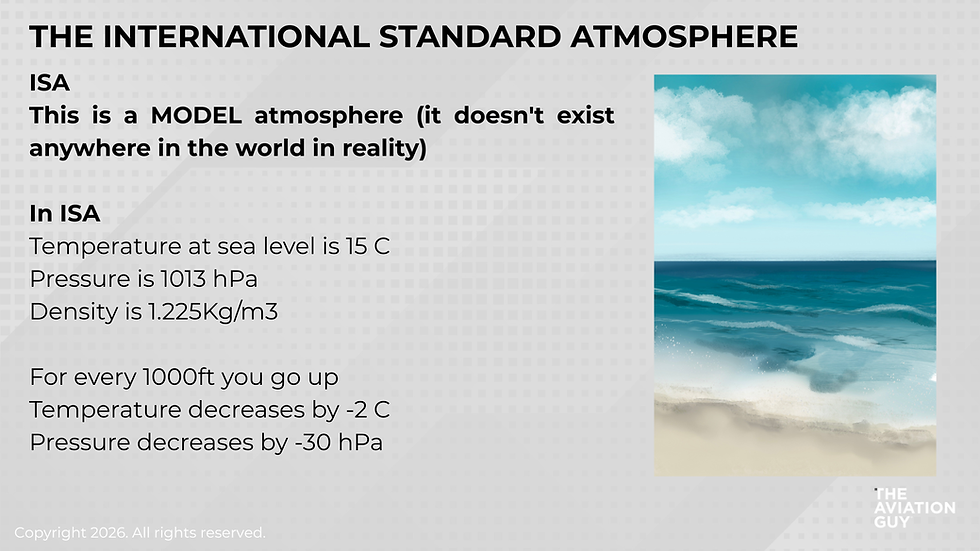
15°C at mean sea level.
1013 hPa at mean sea level.
A density of 1.225 kg/m³ at mean sea level.
And, within the simplified model used in our introductory exercises, approximately:
2°C decrease in temperature for every 1,000 ft climbed.
30 hPa decrease in pressure for every 1,000 ft climbed.
Then came the maths. If the temperature is 5°C in our simplified ISA exercise, approximately what altitude are we at?
If we're at 6,000 ft, approximately what temperature should we expect?
If pressure has fallen by 150 hPa, approximately how far have we climbed?
Students weren't simply recalling numbers. They had to use them.
Finally, into the cockpit: QFE, QNH and standard pressure
The final part of the evening brought everything back to an instrument sitting directly in front of a pilot: the altimeter. An aircraft can measure atmospheric pressure, but the pilot needs to give the altimeter an appropriate pressure reference.
Students were introduced to QFE, which can be used to reference height above an aerodrome; QNH, which allows the altimeter to indicate altitude above mean sea level; and standard pressure setting (SPS), 1013.25 hPa, used when operating using flight levels.
It meant that atmospheric pressure was no longer an abstract scientific concept.
It had become something operational. A pilot needs to understand what pressure reference is being used, what the altimeter is therefore indicating and when that setting needs to change.
50 questions. Two hours. One very busy evening.
Throughout the session, students completed 50 questions designed to progressively test their understanding. Some required straightforward recall. Others required calculations.
And others gave students information and asked them to work out what was happening applying several pieces of knowledge simultaneously. Learning to become a pilot isn't simply about remembering facts long enough to pass an exam.
Pilots need to take information, understand its significance, perform calculations, recognise relationships and then apply that knowledge to a situation. For a 14–19-year-old considering aviation, that's also an opportunity to discover something important quite early:
Do I actually enjoy thinking this way?
Because a career as a pilot involves considerably more than learning how to move the controls.
Turning school subjects into a flight deck
Perhaps the most important part of the evening was seeing familiar school subjects suddenly acquire a purpose. Maths becomes calculating altitude.
Physics becomes understanding pressure, density and the atmosphere.
Geography becomes weather systems and air masses And all of them eventually arrive in the cockpit.
That's exactly what our Become a Pilot Programme is designed to do.
We're not simply telling young people that becoming a pilot is an exciting career.
We're giving them an early introduction to the knowledge, mathematics, science, problem solving and way of thinking they'll encounter when they begin professional flight training.
Last night that journey took us from sunlight hitting the Earth to setting an aircraft altimeter.
Not bad for two hours.
Our next intake starts on Sunday 8th November 2026, give your child a headstart on their pilot career, gain an insight into the profession, get mentored tuition in crucual GCSE & A Level topics, learn how to refine vital pilot skills assessed at interview and get guidance on how write winning flight training applications. Limited spaces available. Registration now open.


Comments